

Part of the Bioidentical Hormone Revolution series
I’ve been saying the same thing for more than thirty years, often to rooms that weren’t ready to hear it: the biggest problem in hormone medicine isn’t the hormones. It’s that almost no one is trained to use them well. For most of my career, that was a message you had to fight to deliver.
This year, one of the most influential philanthropists in the world delivered it for me.
In 2026, Melinda French Gates committed $215 million to women’s health, naming menopause and midlife as a central pillar and calling, in a widely read op-ed, for a “menopause revolution” in this country. But the part that should stop every provider cold wasn’t the dollar figure. It was her answer to the obvious follow-up question—where do we even begin? She didn’t point to a new drug or a new device. She pointed to training. In her words, “better training is an obvious place to start.”
When someone outside this field, with no stake in bioidentical hormones and every resource to study the problem clearly, independently arrives at the exact diagnosis you’ve spent decades making—that’s not a coincidence. That’s confirmation. And it tells you the Bioidentical Hormone Revolution has reached the moment it was always building toward.
The Demand Has Already Arrived
Let’s be honest about the scale of what’s happening. Roughly 6,000 women enter menopause every day in the United States. Patients who used to suffer in silence are now walking into offices and asking for hormones by name. The fear that suppressed this conversation for twenty-three years has lifted, the warnings are gone, and the cultural permission is total.
The money is following the demand. Gates’s commitment is part of a women’s-health and longevity wave that investors and founders have valued in the hundreds of billions. Menopause and midlife health went from invisible to one of the most talked-about categories in medicine in the span of a few years.
So the demand is here. The funding is here. The attention is here. There is only one thing the checkbooks can’t conjure into existence overnight: trained providers.
Money Can’t Buy Competence
This is the part the headlines tend to skip. You can fund research, build clinics, and run national awareness campaigns—and still leave women in front of providers who were never taught to do this work. A $215 million investment doesn’t change what a clinician knows. It only raises the number of patients who will go looking for someone who actually knows it.
The gap is well documented. Only about one in five OB-GYN residents reports any formal menopause education. The specialists women are told to see often received two hours of training on the subject, if that. And so even now, with every regulatory and cultural barrier removed, roughly 75% of symptomatic women still walk away untreated or undertreated. Not because hormones don’t work. Because the training to use them well was never there.
That’s exactly why Gates’s instinct is the right one. Better training is the obvious place to start. The bottleneck was never permission. It was, and still is, mastery.
The Risk Hidden Inside the Good News
Here’s what worries me about this windfall of attention. When demand explodes faster than competence, the market doesn’t wait. It fills the gap with whoever shows up—weekend-certified prescribers, influencers selling “HRT made simple,” seven-minute visits that hand out a patch and a goodbye. More prescribing is not the same as better outcomes. And when undertrained prescribing underperforms, women conclude that “hormones didn’t work for me,” when the truth is that incomplete, untrained hormone therapy didn’t work.
A revolution funded but not staffed with skilled clinicians doesn’t transform women’s health. It just scales the same shallow care to more people. The Bioidentical Hormone Revolution only delivers on its promise if the providers stepping into this moment are trained to practice comprehensive, individualized, evidence-based hormone medicine—not just licensed to prescribe it.
This Is the Opening Providers Have Been Waiting For
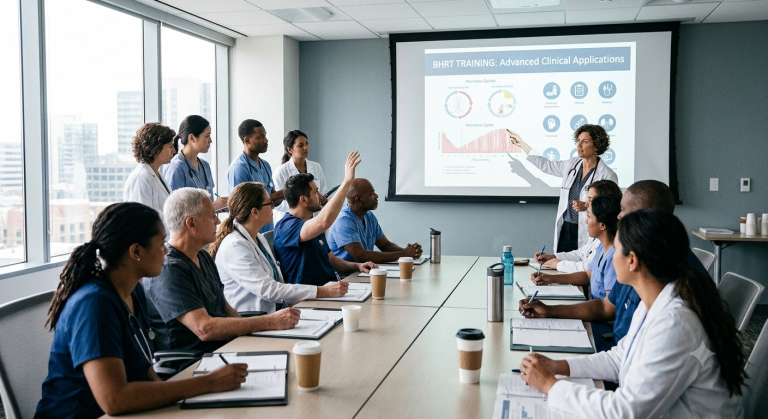
I don’t want any of this to read as discouragement. It’s the opposite. When a figure like Melinda French Gates publicly names provider training as the starting point for a national women’s-health revolution, she is describing, almost word for word, the work the BHRT Training Academy was built to do. The culture has finally caught up to the mission.
So if you’ve ever wondered whether comprehensive hormone training was worth the investment, consider the moment you’re standing in. Demand is at an all-time high. The funding and cultural momentum are unprecedented. And the supply of providers who truly know this work is the scarcest resource in the entire equation. The clinicians who get genuinely trained right now won’t be competing for patients. They’ll be the ones patients are searching for.
The BHRT Training Academy was built for exactly this: not a weekend certificate, but a comprehensive, systems-based, mentored program that takes providers from licensed to masterful—multiple expert faculty, evidence-based protocols, real case review, and ongoing clinical support so you’re never left alone with a complex patient.
Melinda French Gates named the problem. The question is who’s going to be trained to solve it.
Ready to be one of them? Explore the BHRT Training Academy certification program, or schedule a strategy call to see if it fits your practice—and become the provider this revolution actually needs.
Donna White is the founder of the BHRT Training Academy and the international bestselling author of The Bioidentical Hormone Revolution and The Hormone Makeover. Known as The Hormone Defender, she has spent more than three decades helping providers practice comprehensive, evidence-based hormone medicine—on a mission to train 100,000 providers and help 100 million women.
This article is for professional education and is not medical advice. Clinical decisions, including the initiation and dosing of hormone therapy, should be individualized to each patient.
