

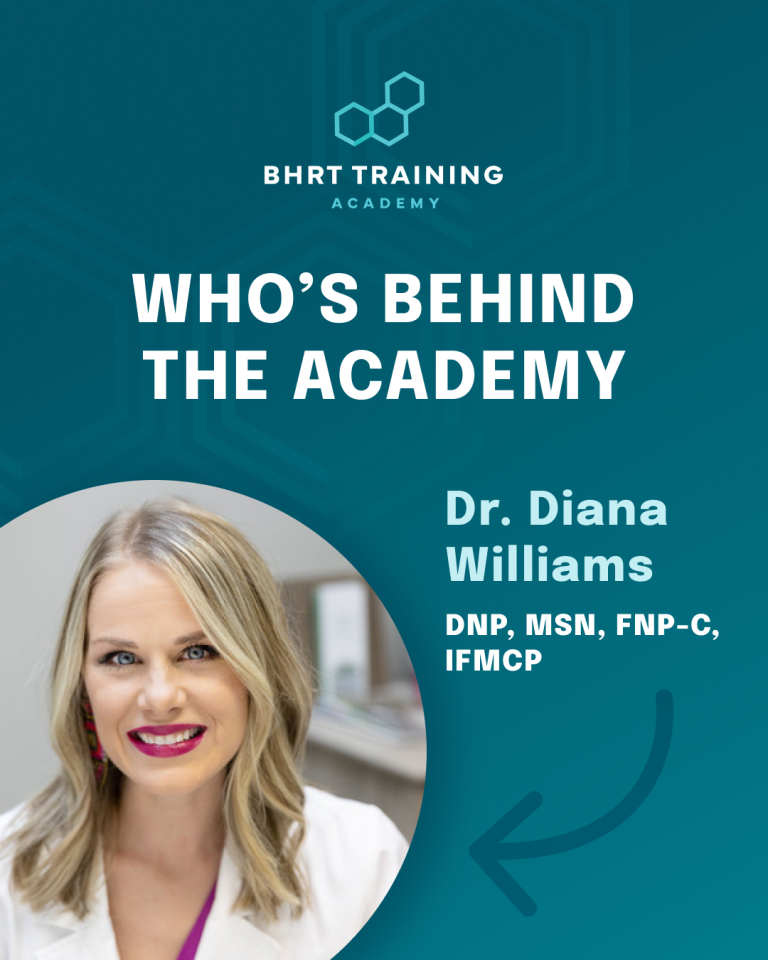
1. What led you into BHRT and this field of medicine?
My own health journey really led me to hormones and holistic medicine. In my early 30s, I was dealing with autoimmune issues, hormone symptoms, anxiety, GI problems, hair loss, insomnia, weight gain—you name it. I knew what it felt like to be told that labs were “normal” when I clearly didn’t feel well.
Functional medicine changed the way I looked at health, and hormones became such an important piece of that. Once I experienced what it was like to actually identify the root causes and restore balance instead of just managing symptoms, I knew this was the kind of medicine I wanted to practice.
2. What drew you to the BHRT Training Academy?
I was drawn to the Academy because it approached hormone therapy in a way that aligned with how I already practiced medicine. It wasn’t simply, “Here’s a hormone, here’s a dose.” It was about understanding the physiology, looking at the whole patient, knowing how thyroid, adrenal health, metabolic health, gut health and sex hormones interact, and then using BHRT safely and appropriately.
I also loved the emphasis on giving providers the confidence to actually implement what they were learning in practice.
3. In your role, what do you focus on most when working with providers?
Confidence and clinical reasoning. Providers can memorize protocols, but I want them to understand why they’re doing what they’re doing.
I really focus on helping providers connect the dots—looking at symptoms, labs, lifestyle, thyroid, adrenal function, metabolic health and hormone patterns together. I want them to get comfortable thinking through the patient rather than treating a number on a lab report.
4. What’s one of the biggest misconceptions providers have about BHRT when they’re getting started?
That there is a perfect protocol or a perfect lab value.
Providers often want someone to tell them, “If estradiol is X, prescribe Y,” but people just don’t work that way. Labs are incredibly helpful, but they’re one piece of the clinical picture. Great hormone management requires understanding physiology, symptoms, risk factors and the individual patient—and then being willing to adjust. Providing good hormone optimiazation requires such an individualized, artistic approach, and the humility to know that what works for one may not work for another.
5. What separates providers who truly succeed in BHRT from those who don’t?
The providers who succeed stay curious.
They don’t just learn a protocol and repeat it forever. They continue studying, they listen to their patients, they follow outcomes, and when something doesn’t make sense, they dig deeper.
I also think the best BHRT providers understand that hormones don’t exist in isolation. If you ignore insulin resistance, thyroid function, inflammation, nutrient deficiencies, stress, sleep and gut health, you’re going to miss a huge part of the picture.
6. What’s one mindset shift that changes everything for providers in this field?
Stop chasing “normal” and start asking what is optimal for this individual patient.
A reference range can tell you whether someone falls within a statistical population, but it doesn’t necessarily tell you why that person feels terrible. When providers start combining the objective data with the patient’s symptoms and physiology, they begin practicing very differently.
7. What do you love most about working with providers inside the Academy?
I love watching the moment when it starts to click.
A provider may initially feel overwhelmed by hormones, labs and all of the different variables. Then they start connecting the dots and suddenly they’re bringing in cases and saying, “I think I know what’s happening here.”
That confidence is really rewarding because I know how many patients that provider is ultimately going to be able to help.
8. What excites you most about the future of hormone medicine?
I think we’re finally moving away from the idea that women—and men—should simply accept feeling poorly as a normal part of aging.
Patients are asking better questions, providers are becoming better educated, and we’re learning more about the relationship between hormones and metabolic health, cardiovascular health, bone health, cognition, sexual health and longevity.
I’m excited to see hormone optimization become part of a much bigger conversation about helping people stay healthy and functional as they age. I am confident that hormone optimization will pioneer a new way of practicing medicine and excited to be a long for the journey.
9. For someone considering this field, what would you say to them?
Do it—but commit to really learning it.
Hormone medicine is incredibly rewarding because you can make such a meaningful difference in someone’s quality of life. But don’t approach it as simply adding BHRT to your menu of services. Learn the physiology. Learn how to assess the whole patient. Find good mentors. Ask questions. Follow your patients closely.
The confidence comes with experience, and you don’t have to know everything before you start.
10. When you’re not working, what do you enjoy doing?
My favorite thing is spending time with my family. My husband Allan and I have three girls, so life outside of work is pretty full! We love traveling together, and I’m always planning our next trip or finding somewhere new for us to experience.
I also genuinely love creating things—whether that’s a new business concept, designing a space, or dreaming up the next project. I’m not very good at sitting still.
11. Fun fact — we have to ask!
I think a fun fact about me is that I never really intended to become an entrepreneur. I started Strategic Wellness Center in 2018 because I wanted to create the kind of healthcare experience I wished I had received during my own health journey. One thing led to another, and apparently my hobby became building businesses!
